Virello Pest ManagementVirello Pest Management

Rodent Exclusion and Abatement Cincinnati

Rodent exclusion and abatement resolves the vulnerabilities of older architecture found across Hamilton County, particularly historic brick rubble foundations in Over-the-Rhine, fieldstone basements in Clifton, and…
Get My Estimate →(513) 812-8088
Rodent Exclusion and Abatement in Cincinnati, OH
Quick answer
  • Complete structural inspection, foundation gap sealing with galvanized steel mesh, entry door adjustments, and mechanical trap extraction.
  • Initial diagnostic inspections take roughly 60 to 90 minutes, with sealing repairs completed within 1 to 2 operational days.
  • Ballpark investment ranges from $200 for basic entry denial to $1,850 for extensive structural retrofitting, with exact pricing confirmed on-site.
  • Active house mice, Norway rats, roof rats, compromised crawl space entryways, and contaminated nesting debris are systematically cleared.
  • Schedule by contacting Virello Pest Management at (513) 812-8088 to reserve a scheduled diagnostic inspection window.

Rodent exclusion and abatement resolves the vulnerabilities of older architecture found across Hamilton County, particularly historic brick rubble foundations in Over-the-Rhine, fieldstone basements in Clifton, and framing gaps common near wooded ravines in Mount Lookout and Mount Adams. Rather than depending on toxic surface repellents or unanchored baits, structural exclusion denies physical access to pests attempting to exploit 0.25-inch voids. Homeowners observing attic scratch marks, shredded blown-in insulation, or perimeter droppings require physical barrier denial because outdoor rodents continuously exploit utility pipe penetrations, basement window wells, and degraded mortar joint channels.

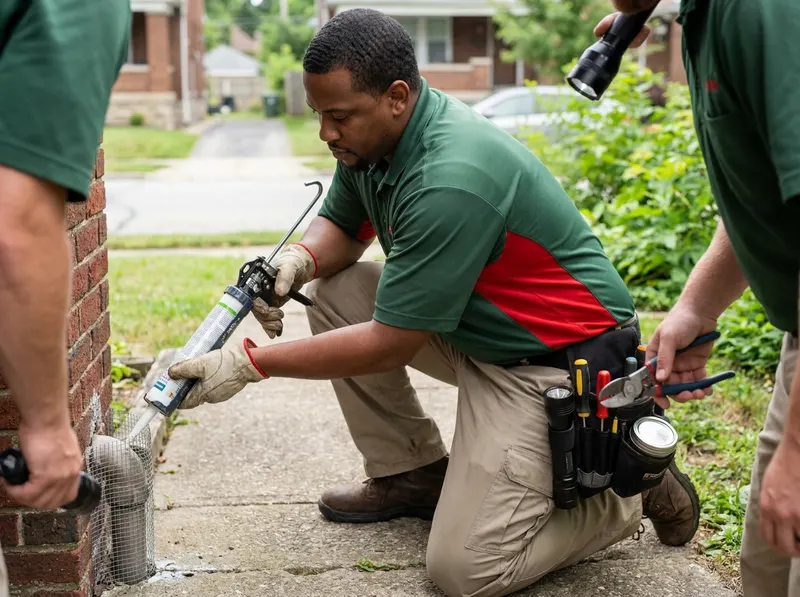
Effective rodent management adheres strictly to guidelines set by the CDC Rodent Prevention Standards, which prioritize physical building envelope sealing over open-air poisons. When house mice (Mus musculus) or Norway rats (Rattus norvegicus) chew through drywall or nesting materials near heating units, mechanical perimeter defense becomes mandatory. Virello Pest Management installs non-corrosive, 19-gauge ASTM-compliant galvanized steel hardware cloth across weep holes, crawl space ventilation grates, and soffit edges to form an impenetrable barrier that rodents cannot gnaw through.

Choosing permanent structural exclusion over disposable snap traps or temporary hardware-store bait blocks eliminates the cycle of recurring seasonal invasions. Consumer-grade poison trays frequently result in rodents expiring within interior wall cavities, creating odor contamination, biohazard concerns, and carpet beetle outbreaks. Mechanical abatement involves placing locked, tamper-resistant capture stations along established indoor runways according to safety practices established by the EPA Rodenticide Safety Guidelines, removing captured pests directly without releasing toxic agents into living areas. Following population removal, technicians apply botanical antimicrobial washes to neutralize hazardous rodent urine pheromones and pathogen residues.

    Step 1: Conduct a complete 360-degree perimeter survey of the roofline, foundation wall, and floor joists to identify active travel tracks and entry points. Step 2: Form solid physical barriers using expanding foam reinforced with steel mesh and heavy-duty metal flashing across every exterior gap larger than 6 millimeters. Step 3: Install interior closed-box mechanical capture systems throughout non-living zones like attics, crawl spaces, and basements. Step 4: Monitor and empty capture units every 24 to 72 hours until zero activity is detected across three consecutive visits. Step 5: Sanitize impacted floor areas, replace rodent-soiled crawl space vapor barriers, and apply non-hazardous disinfectants. Step 6: Complete a closing envelope assessment to confirm all outdoor access routes remain fully barred.

Different home designs dictate the scope of remediation. In brick and stone colonials around Hyde Park, Oakley, and Pleasant Ridge, settling often splits sill plates away from foundation walls, requiring heavy copper mesh packing, masonry pointing, and customized aluminum sheet metal flashing. Modern multi-level homes near College Hill or Northside often develop issues within attached garages, crawl spaces, and low-hanging fascia boards, which demand the addition of heavy-duty brush seals along garage door bottoms to block ground-level entries. The primary trade-off involves prioritizing upfront physical repair over perpetual bait stations; comprehensive exclusion requires meticulous labor, yet it yields durable protection without dispersing poisons near household pets.

How much does Rodent Exclusion and Abatement cost in Cincinnati?

Entryway Seal & Targeted Door Sweep Installation$200 - $350
Standard Foundation & Crawl Space Exclusion (Up to 2,000 sq ft)$450 - $850
Comprehensive Historic Home Exclusion & Sill Plate Fortification$900 - $1,450
Full-Attic Exclusion, Sanitization & Bio-Decontamination$1,200 - $1,850

Every job gets a firm, written price after an on-site visit.

Common questions

What is the typical cost for rodent exclusion in Cincinnati?
Basic entry point repair begins at our $200 minimum charge, while comprehensive home exclusion and decontamination across Cincinnati properties averages between $450 and $1,450 depending on foundation size.
Why are rodents entering my Cincinnati home during autumn and winter?
Dropping outdoor temperatures across Cincinnati push rodents toward heating pipes, basements, and attic insulation where warm air escapes through unsealed foundation cracks as small as a dime.
How does professional exclusion compare to standard hardware store traps in Cincinnati?
Retail traps only eliminate a fraction of the current population without closing exterior gaps, whereas professional exclusion mechanically seals every access pathway into the Cincinnati residence to prevent re-infestation.
Do exclusion materials withstand persistent gnawing by rats in Cincinnati?
Technicians use 19-gauge galvanized hardware mesh, heavy gauge copper packing, and sheet metal flashing that rodents cannot compromise, even along tough Cincinnati limestone foundations.
Will technicians need to drill through finished walls inside my Cincinnati property?
Perimeter sealing occurs along exterior building lines, attics, and unfinished basement runs, meaning finished interior walls within Cincinnati homes are rarely disturbed during installation.

Get started today

Tell us about your rodent exclusion and abatement job in Cincinnati and we'll send a clear, written quote, usually the same day.

Get your PEST CONTROL SEVICE quote, Cincinnati

We only use your ZIP to check availability, no spam.